Between 10:00 PM on Saturday December 16 and 4:00 AM on Sunday December 17 (Pacific time), approximately 25% of our hosting servers will be restarted. This will cause a brief interruption of service (less than 10 minutes) for those sites at some point during this 6 hour period.
Between 10:00 PM and 11:59 PM Pacific time on Friday, September 29, each of our hosting servers will be restarted. This will cause a brief interruption of service (less than 5 minutes) for each site at some point during this 2 hour period.
This bug is being exploited by “hackers” who have used it to download the private “wp-config.php” file of many WordPress sites. It’s then possible to use the private information in that file to login to your WordPress dashboard without knowing the password, or to modify your site’s database.
We’ve added firewall rules to block downloads of that file via the bug, but in addition, we’re taking the following steps to protect our customers who were using a vulnerable version of the BackupBuddy plugin at any point between August 26 and September 8:
Changed the backend WordPress database password to a new random one; and
Changed the WordPress “salts” in the wp-config.php file.
These are the steps recommended in the post by the BackupBuddy authors, so our customers don’t need to do this themselves. (The post also suggests an optional third step, but that doesn’t apply to most WordPress sites.)
The only difference affected customers should notice is that WordPress may ask for your normal password again the next time you login, rather than “remembering” you from a previous login.
Finally, keep in mind that we already make daily backups of your website at no extra charge. We never want to discourage people from making their own additional backups, but those extra backups are most useful if they’re stored in another location (not just on the same server you’re making a backup of). While investigating this, we noticed that most people using BackupBuddy are simply storing an extra copy on the same server, which doesn’t add much protection against data loss. If you make your own backups, you should ideally copy them to your own computer, or to an external location like Dropbox.
The good news is that we don’t use the vulnerable versions of the kernel software on our servers, and we’ve verified in multiple ways that our servers are not vulnerable to this problem.
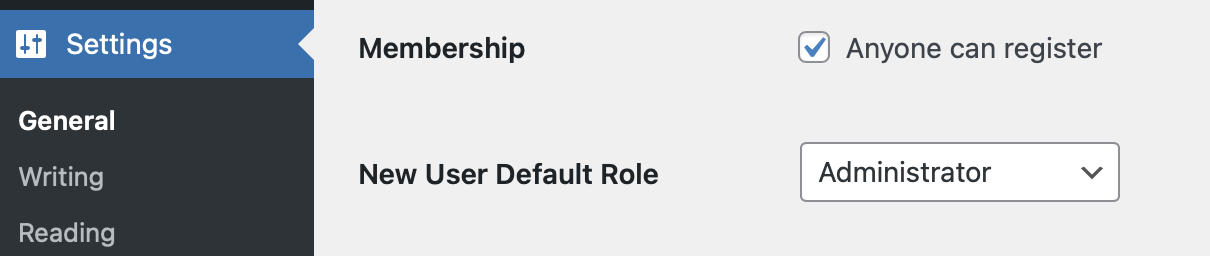
If you use WordPress, and you allow strangers to register for WordPress accounts (which isn’t usually a good idea, but some plugins require it), it’s possible to accidentally configure it so that those new users get created as WordPress administrators. That can happen simply by doing this:
We don’t think it’s reasonable to ever create new users as “Administrators” by default, regardless of whether you have “anyone can register” turned on. (Even if “anyone can register” is turned off now, it would be easy to turn it on later without remembering to change the default role back.)
To make sure our customers’ sites stay secure, we’ve added some protections against this:
Setting the “New User Default Role” to “Administrator” is blocked at the Web Application Firewall (mod_security) level on our servers, whether from the WordPress dashboard or from any other web request;
If it somehow gets set anyway, our security systems will detect it as part of the daily security scan we do of every site;
If your site already had this setting as of today, we’ve restored it to the default “Subscriber” role.
Nobody should notice any changes as a result of this, but as always, don’t hesitate to contact us if you have any questions or difficulties.
The good news is that we don’t use the Log4j software anywhere on our servers, and never have. We’ve verified in multiple ways that our servers are not vulnerable to this problem.
That said, we always believe in “defense in depth” when it comes to security, so we’ve also added rules to our web application firewall that will block any IP addresses making attempts to exploit this bug.
Between 10:00 PM and 11:59 PM Pacific time on Friday, July 16, each of our hosting servers will be restarted. This will cause a brief interruption of service (less than 5 minutes) for each site at some point during this 2 hour period.
Some customers have asked us whether our servers are vulnerable to this problem.
The good news is that we don’t use Microsoft Exchange (or any other Microsoft email server) software, and never have. That means our servers, and our customers who use our email services, are not vulnerable to this problem at all.
If you’ve previously installed an older version of WordPress, you should update it from within your WordPress Dashboard.
One great new feature of WordPress 5.5 is that it adds automatic updates of plugins and themes. We strongly recommend enabling this feature to improve the security of your site. To do that, just click “Enable auto-updates” for all your plugins and themes:
That’s all it takes to prevent most “hacker” attacks on your site.
Recently, Let’s Encrypt found a problem with some certificates that could cause site visitors to see security warnings if the certificate wasn’t renewed before noon Pacific time today (March 4, 2020).
Our customers don’t need to worry, though. We’ve already renewed any affected certificates, so the problem will not affect any sites we host.
There’s a website at checkhost.unboundtest.com you can use to test your certificate if you want to be sure. As always, don’t hesitate to contact us if you have any questions.